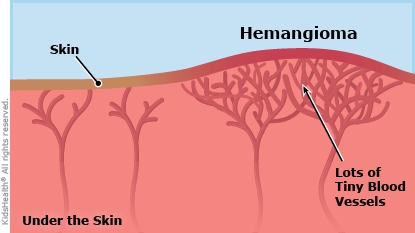
A congenital hemangioma (he-man-jee-OH-muh) is a type of birthmark that is made up of tiny blood vessels and is usually red, blue, or purple. They may also be flat or bulging, small, or large. Most congenital hemangiomas are found on the skin.
Some congenital hemangiomas shrink or go away completely. Others stay about the same size or grow slowly as your child gets older. If needed, there are treatments that may remove or help shrink a congenital hemangioma.
Here's how to care for your child.

Follow your healthcare provider's instructions for:
- Making any appointments with a dermatologist (skin specialist)
- Taking your child for any testing
- Whether it's OK to give acetaminophen (Tylenol® or a store brand) or ibuprofen (Advil®, Motrin®, or a store brand) for pain if the hemangioma becomes irritated (Follow the directions on the label for how much to give and how often. Don't give ibuprofen to babies under 6 months old.)
- Making any follow-up appointments
If the hemangioma bleeds:
- Use a clean cloth to hold firm pressure on the hemangioma for five minutes.
- Lift the cloth to see if bleeding has stopped.
- If bleeding hasn't stopped, continue to hold firm pressure on the hemangioma for five more minutes.
- Lift the cloth again to check if bleeding has stopped.
- If the bleeding has not stopped, keep holding firm pressure and call your healthcare provider.

What causes congenital hemangiomas and who gets them? Healthcare providers do not fully understand how congenital hemangiomas form. They may run in families.
Will a congenital hemangioma shrink? This depends on the type of congenital hemangioma. There are three kinds of congenital hemangiomas:
- Rapidly involuting congenital hemangioma (RICH): This type starts to shrink (involute) without treatment right after the baby is born and is mostly gone by the time a child is 12–14 months old. Sometimes a scar or other change in the skin remains.
- Non-involuting congenital hemangioma (NICH): This type does not shrink. It grows with the baby, staying roughly the same size relative to the baby's body.
- Partially involuting congenital hemangioma (PICH): This type grows with the baby a little bit, then starts to shrink. It does not fully disappear.
When does a hemangioma need to be treated? The healthcare provider may recommend surgery, laser therapy, or other treatment if the hemangioma:
- Becomes irritated, develops a sore, gets infected, or bleeds a lot
- Gets in the way of eating, breathing, hearing, or seeing because of its size and where it is
- Causes heart problems because of the amount of blood flowing through it
- Is very big or is upsetting to the parents or child
There are no oral (taken by mouth) medicines or creams that can treat a congenital hemangioma.