Vertebral Compression Fracture: How to Care for Your Child

The vertebrae (or "vertebral bodies") are the bones that form the spinal column. A vertebral compression fracture (break) of the spine means one or more of these bones has collapsed. Treatment helps the bones heal. For most kids, this includes taking a break from activities that stress the bones and following your health care provider's instructions

Here's how to care for your child.
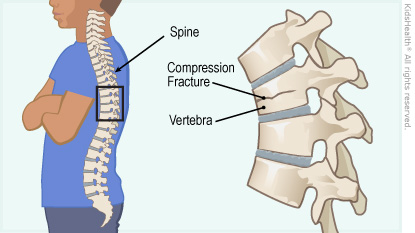
Care Instructions

  • To help the fracture heal:
    • Your child should avoid sports and rough play. Follow your health care provider's instructions about which activities are OK.
    • Walking, stretching, and other gentle exercise can help. Encourage your child to be a little more active each day as the pain lessens.
    • Your child can use pillows under or behind the back to improve comfort when sitting or lying down.
    • If the health care provider gave your child a back brace or a neck brace, make sure your child wears it as directed.
    • If the health care provider recommended physical therapy, be sure your child goes to all appointments.
  • For pain:
    • Give your child any medicines your health care provider recommends for pain. These may include prescription pain medicine, acetaminophen (Tylenol® or a store brand), or ibuprofen (Advil®, Motrin®, or a store brand). Some prescription pain medicines also include acetaminophen or ibuprofen. To avoid giving too much, give the medicines exactly as directed by your health care provider.
    • Put heating pads or warm compresses over the painful spot. Wrap a towel around the compresses or heating pads to prevent burns.

  • Pain does not improve after 2 weeks.
  • Your child has bad pain even after taking pain medicine.
  • Pain keeps your child from sleeping at night.

Go to the ER if...

  • Pain, numbness, or tingling (pins and needles) gets worse or spreads to a new area.
  • Your child has pee or poop accidents.
  • Your child has trouble walking.

More to Know

How do compression fractures happen? Compression fractures can happen from a serious fall or accident, such as a sports injury or a car crash. Some kids have weak bones from a medical condition. Kids with weak bones can get compression fractures from smaller stresses, like tripping or even coughing.

How do health care providers diagnose compression fractures? Health care providers will talk to your child about their symptoms, do an exam, and order imaging tests, such as X-rays, a CT scan, or an MRI. They also might do a bone density test. This test tells the health care provider if a child has weak bones.

How long will it take the fracture to heal? For most kids, healing takes 2–3 months. But pain usually gets better sooner, in 3–6 weeks. After the bones heal, some children need to do special exercises to get their strength back. Kids with weak bones may need to take medicine to keep fractures from happening again.

