
Giving an enema is a procedure in which liquid is put into the anus (the opening where poop comes out) and into the rectum (where poop is stored until it leaves the body).
Enemas are used to treat constipation (when your child poops less than usual or has dry, hard, or difficult-to-pass poops) or to give medicines. Here's how to give your child an enema.

Read the instructions. Follow the package directions carefully. Make sure that the enema you're using is the right one for your child's age and weight. Don't use an adult enema. Don't give your child enemas more often than directed. Don't give an enema to a child younger than 2 years of age.
Create a relaxing atmosphere for your child. This can include music, TV, video games, a toy, someone reading a story, or rubbing their back — anything that will be calming and distracting. Encourage your child to take deep breaths. Show the tip of the enema to your child so they know what you will be inserting into their anus.
Wash hands and wear gloves. Clean your hands and put on disposable gloves.
Prepare for the enema. Place a pad or thick towels under your child's bottom. You can also keep a bedpan or bucket nearby in case your child can't hold in the fluid.
Set up the enema. Warm the enema liquid by running the bag, bulb, or bottle under warm water. Test the liquid on your wrist to make sure it isn't hot.
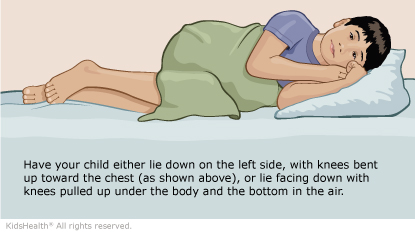
Position your child. Have your child either:
Insert the enema. Stop if the tube doesn't go in easily. Wait a few minutes, then try again. Asking your child to push gently (as if pooping) may make it easier to slide it in.
Check on your child. If your child has belly pain, stop squeezing the bottle or pinch the tube to stop the enema. Encourage your child to relax and take deep breaths. When the pain stops, start giving the enema again. If using a bag and tube, it may help to lower the bag, so the liquid flows more slowly.
Help your child sit for the recommended time. After you have completed the enema, your child should stay lying down, holding in the enema fluid for the time recommended by your healthcare provider and the package instructions. It may help to gently hold the buttocks together with your hands. After the recommended time, have your child sit on the toilet and let the enema fluid and poop come out. The poop may be watery. Your child may have to go to the toilet more than once.

Your child:

Why do healthcare providers prescribe enemas? In kids and teens, the most common reason is to treat constipation. But healthcare providers usually recommend other treatments first, such as taking medicines by mouth and making changes to the diet. Healthcare providers also prescribe enemas to give medicines for certain medical conditions or pain relief.

