Toddler's Diarrhea: How to Care for Your Child

Toddler's diarrhea happens when a young child has loose, watery poop (diarrhea) at least 4 times a day for 4 weeks in a row. It's called "toddler's diarrhea" because it happens in kids who are 6 months to 5 years old. A child with toddler's diarrhea continues to eat, grow, and gain weight normally. The diarrhea doesn't make a child less active or less energetic.

Kids with toddler's diarrhea may have loose poop all the time. Or they may have poops that are harder in the morning but that get looser throughout the day. The poop may have small pieces of food in it.

Most kids outgrow toddler's diarrhea. Making changes in your child's diet may help it go away faster.

Care Instructions

Follow your healthcare provider's instructions for:

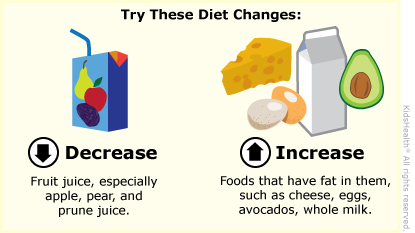
  • Limiting juice (it can make diarrhea worse):
    • Babies under 1 year shouldn't have any juice.
    • Babies 1 year and older can have white grape juice, but limit it to less than 4 ounces a day. Don't give apple, pear, or prune juice.
  • Increasing fat (to bulk up stools). For example, if your child drinks low-fat or nonfat milk, switch to whole milk.
  • Increasing fiber in the diet over a few weeks (to bulk up stools):
    • For kids younger than 4 years old, try pureed fruits, small pieces of cooked fruits and vegetables, and baby cereals (such as bran or oatmeal). Do not give kids younger than 4 years old hard, raw fruits or vegetables, or other foods that can cause choking.
    • For kids older than 4 years old, try small pieces of raw fruits and vegetables (leave the skin on when possible), dried fruit, nuts, and whole-grain breads and cereals.

Other important instructions:

  • Help your child:
    • Avoid sugary drinks
    • Eat a well-balanced diet
  • Keep a food diary to track what your child eats and drinks to find out what helps the poop become more firm. Include:
    • What your child ate
    • When your child pooped, whether it was soft or firm, and whether there was anything different about the poop (such as having small pieces of food in it)
  • Do not give any medicines unless the healthcare provider prescribed or recommended them. This includes medicines you can buy at the store without a prescription.

Your child:

  • Has worsening diarrhea
  • Has black poop or poop with streaks of blood or mucus in it
  • Starts to vomit
  • Gets a fever
  • Does not want to eat as much as usual, loses weight, or isn't gaining weight as expected

Go to the ER if...

Your child:

  • Is vomiting again and again
  • Is crying a lot and can't be calmed down
  • Has severe belly pain

You know your child best. If your toddler seems very sick or has symptoms that worry you, call your healthcare provider or take your child to the ER.

More to Know

Why do some kids get toddler's diarrhea? The cause of toddler's diarrhea is not known. It is common in young kids. It may happen when food moves through a child's intestines too quickly. When this happens, liquid in the food isn't fully absorbed into the body. The extra liquid stays in the intestines, leading to loose, watery poops.

Toddler's diarrhea also may happen when toddlers drink too much fruit juice, sports drinks, and other sweetened drinks. Sometimes it begins after a child has an infection. For some kids, a low-fat or low-fiber diet may be the cause.