Phimosis: How to Care for Your Child

An uncircumcised penis has a hood of skin, called the foreskin, around the end. Phimosis is a condition that happens when the foreskin can't be pulled back (retracted). This is normal at birth, and over time, the foreskin gradually separates from the end of the penis and can be pulled back.

Your child's phimosis (fy-MO-sis) is not a cause for concern at this time. In most kids, the foreskin fully retracts by puberty. Follow these instructions to care for your child while the phimosis naturally goes away.

Care Instructions

Use any cream or ointment your healthcare provider prescribes.

For babies, follow these steps:

  1. Clean the penis every day with warm water and a gentle soap that is not irritating. Rinse the penis if you use soap. Don't use alcohol, scented soap, or any other antiseptic.
  2. Dry the penis with a clean towel.
  3. As long as your healthcare provider says it's OK, you can gently move the foreskin back to clean the penis, but don't force the foreskin to pull back. When you are done, always pull the foreskin back down over the penis.

As your child gets older and their foreskin starts to retract, teach your child how to clean under the foreskin every day.

Your child can follow these steps:

  1. Gently pull back the foreskin.
  2. Clean the penis with warm water and a gentle soap that is not irritating. Rinse the penis if using soap.
  3. Dry the penis with a clean towel.
  4. Pull the foreskin back to its original place over the penis.

Once your child is comfortable with these steps, they can clean under the foreskin on their own. Be sure they know the right soap to use and to pull the foreskin back to its original place over the penis when finished.

  • Your child's urine (pee) stream is crooked or dribbles out.
  • The pee gets trapped inside the foreskin, causing the foreskin to balloon out. This sometimes happens just before the foreskin retracts fully. Check with your healthcare provider just in case it is a sign of a problem.
  • Your child strains to pee.
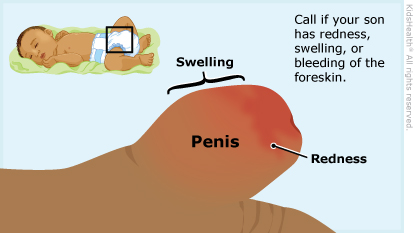
  • The foreskin or penis looks red or swollen.
  • There is bleeding from the penis or foreskin.
  • Your child can't retract the foreskin by the time they go through puberty.
  • Your child was able to retract the foreskin but no longer can.
  • Your older child has pain during erections.
  • Your child has signs of a urinary tract infection (UTI), such as:
    • Peeing more often than usual.
    • Pain when peeing.
    • Foul-smelling, bloody, or cloudy pee.
    • Belly or back pain.
    • Fever. If your child is younger than 3 months old and has a rectal (taken in the bottom) temperature of 100.4°F (38°C) or higher, take them to the ER.
    • Increased fussiness, poor feeding, or vomiting, in babies.

Go to the ER if...

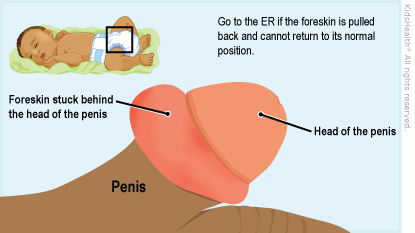
  • Your child's foreskin retracts, then can't be pulled back down over the penis.
  • Your child can't pee.
  • The head of the penis is swollen, very painful, or has a change in skin color.
  • Your child is younger than 3 months old and has a rectal (taken in the bottom) temperature of 100.4°F (38°C) or higher.

More to Know

What causes phimosis? Phimosis is normal in uncircumcised babies because the foreskin is attached to the end of the penis at birth. Phimosis in older kids and adults usually happens from an injury or an infection.

How is phimosis treated? In babies and young children, phimosis usually goes away with regular care. Sometimes the healthcare provider will prescribe a cream or an ointment to help loosen the foreskin. Very rarely, surgery is recommended. In older kids and adults, other treatment may be needed, depending on the cause of phimosis.

Learn More