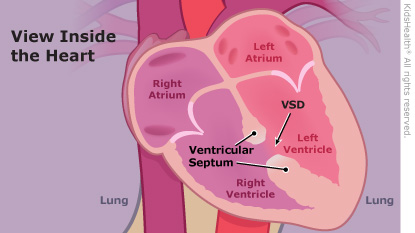
A ventricular septal defect (VSD) is a hole in the ventricular septum (the wall that normally separates the heart's two ventricles, or lower chambers of the heart). The hole lets blood move from the left ventricle into the right ventricle. If the hole is large, it can cause extra blood to go to the lungs. This can cause problems in the lungs and put stress on the heart.
A small VSD usually does not cause symptoms and doesn't need treatment. A larger VSD may need surgery to close it. Your cardiologist (heart specialist) will help you get the right treatment for your child.

Follow your healthcare provider's instructions for:
- Giving any medicines to your child
- Feeding your child (Babies with larger VSDs may need to have smaller, more frequent feedings or need extra calories to grow.)
- Scheduling all follow-up appointments as recommended by the cardiologist
Kids with a VSD are more likely to get lung infections and can get endocarditis, a heart infection caused by bacteria (germs) in the bloodstream. Be sure to have your child:
- Get any special immunizations (shots) to prevent lung infections as recommended by your healthcare provider.
- Brush their teeth twice a day, floss every day, and see a dentist regularly to lower the amount of bacteria in the mouth since it can spread to the heart and cause endocarditis. If your child has surgery for the VSD, they will need to take antibiotics before seeing the dentist for several months after the surgery.

Your child has signs that extra blood is going through the VSD to the lungs, such as:
- Fast breathing
- Not gaining weight or growing as expected
- Tiring more easily than expected
- Not feeding well (for babies)

How does a VSD change blood flow in the heart? Normally, the blood is pumped from the left ventricle out to the body. In kids with a VSD, some of the blood from the left ventricle leaks into the right ventricle. That means:
- The left ventricle has to pump harder to get enough blood to the body. This can make a baby or child tired and lead to poor growth.
- The extra blood in the right ventricle flows into the lungs. This can lead to fluid buildup in the lungs and over time damage the lungs. It can also cause more frequent lung infections and other problems.
What is a heart murmur? A heart murmur is an extra noise that blood makes when flowing through the heart. Healthcare providers can hear a heart murmur when listening to the heart with a stethoscope. People with a VSD usually have a heart murmur.
What tests or procedures might my child need for a VSD? Your child's healthcare provider may order:
- Chest X-ray
- Electrocardiogram (EKG), a test that measures the heart's electrical activity to show how it's working
- Echocardiogram or “echo,” an ultrasound (medical imaging scan) to take pictures of the heart
- Heart catheterization, a procedure in which a catheter (a thin, soft plastic tube) is put into a blood vessel in the arm or leg, then threaded to the heart (The catheter takes measurements and pictures to help the cardiologist better understand what's going on in the heart.)
How is a VSD treated? A small VSD may not need treatment. If needed, the VSD can be fixed with surgery or catheterization:
- For surgery, the surgeon puts a patch over the hole or, less commonly, sews the hole closed.
- For catheterization, the catheter is used to carry a small device to the heart to plug the hole. Over time, the heart tissue grows around the device, holding it in place.