
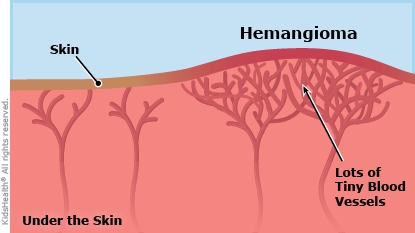
An infantile hemangioma (he-man-jee-OH-muh) is a type of birthmark made up of tiny blood vessels. They appear a few days or weeks after a baby is born. They are usually bright red, purple, or bluish, and might be small or large, flat or bulging, or bumpy or smooth.
Most infantile hemangiomas are on the skin. Usually, kids have only one, but sometimes they can have a few. Infantile hemangiomas generally don't require treatment and go away on their own.
Here's how to care for your child.

Follow your healthcare provider's instructions for:
If the hemangioma bleeds, follow these steps:


Why do infantile hemangiomas happen? Healthcare providers do not fully understand why infantile hemangiomas form. It may be related to changing oxygen levels that happen while the baby is developing in the womb. They are more common in girls, in multiple births (such as twins or triplets), and in babies who are born prematurely (early).
Will my child's infantile hemangioma go away? Infantile hemangiomas can get bigger at first, but most start to go away when children are 9–18 months old. They slowly fade and flatten by the time a child is 4 years old. Sometimes, a scar remains.
Does my child need any testing for the hemangioma? Often, no testing is needed. If a baby has many (more than five) hemangiomas on the skin, a healthcare provider might order an ultrasound or an MRI (magnetic resonance imaging) test, since very rarely, hemangiomas can be inside the body.
When does an infantile hemangioma need treatment? Most of them do not need treatment. The healthcare provider may recommend cream, medicine, surgery, or other treatment if an infantile hemangioma:

