Constipation: How to Care for Your Child or Teen

Constipation means having fewer bowel movements (poops) than usual, or having dry, hard, or difficult-to-pass poops.

Eating more fiber, drinking more water, not holding in the poop when they have the urge to go, and getting plenty of physical activity can all help constipation get better for most kids. Some kids will also need medicine.

Treating constipation right away is important because it can get worse over time. Here's how to care for your child.
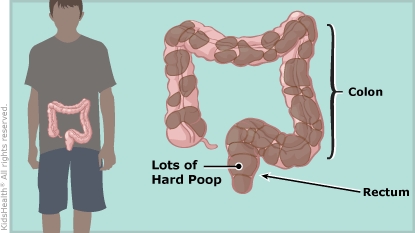

Illustration of a teenager and callout of what the colon and rectum looks like during constipation.

Care Instructions

  • Increase fiber in your child's diet by offering high-fiber foods, such as:
    • Apples, pears, beans, oatmeal, oranges, ripe bananas, whole-grain breads, and popcorn
    • Fruit smoothies with added flax meal or bran

  • Encourage your child to drink plenty of water. Have them keep a water bottle with them so they can sip on it throughout the day.
  • Follow your healthcare provider's recommendations for:
    • Giving your child any medicines
    • Any foods your child should avoid (Certain foods, like dairy, can make constipation worse in some kids.)
    • If your child should drink prune, pear, or apple juice
    • When to follow up
  • Encourage your child to get plenty of physical activity. It can help with constipation and overall health.
  • Stress can lead to constipation. To help your child cope with stress:
    • Have them try meditation or yoga.
    • Be sure they get enough sleep.
    • See if they want to talk to a counselor.
    • Talk to them about how too much screen time may increase stress.
    • Help them balance school and activities with enough time to relax/recharge.
  • Create a bathroom routine:
    • Encourage your child to sit on the toilet for about 5–10 minutes a few times a day, especially after meals (since they are more likely to poop after a meal).
    • If your child feels the urge to poop, they should go to the toilet and sit for 5–10 minutes to see if they can poop.
    • While using the toilet, have your child prop up their feet about 6–9 inches on a stool so their knees are higher than their hips. This can make it easier to poop.
    • If your child is uncomfortable using the bathroom at school because there are a lot of people around, work with the school nurse to find a bathroom that's more private.
  • Talk to your healthcare provider before giving your child any supplements or herbs.

Your child:

  • Doesn't poop within 2–3 days after following the healthcare provider's instructions
  • Has new or worsening belly pain, diarrhea (watery poop), vomiting, streaks of blood on the toilet paper, in the toilet, or on their poop
  • Soils their underwear
  • Seems to be losing weight

Go to the ER if...

Your child:

  • Has severe belly pain or a hard, swollen belly
  • Is vomiting again and again
  • Has a lot of blood on the toilet paper, in the toilet, or on their poop

More to Know

What causes constipation in kids? In kids, constipation is usually caused by a combination of:

  • Not getting enough fiber or water in the diet
  • Holding in poop because of fear that it will be painful or not wanting to poop in a public bathroom
  • Not having enough physical activity
  • Stress

Less often, constipation in kids is caused by certain medicines or a medical condition.

What are the symptoms of constipation? Kids with constipation may feel full or bloated, might not want to eat as much, and may strain or have pain while trying to poop. They may also have small streaks of bright red blood on the toilet paper, in the toilet, or on their poop. This happens because the child gets small tears in the skin around the anus (where the poop comes out) from straining to get the poop out. Kids who have constipation for a long time may have soiling when liquid poop leaks out around hard poop that is backed up in the rectum (lower part of the bowels).

Once their constipation is better, how often should my child poop? For some people it's normal to poop one or more times a day, and for others, it's normal to poop a few times a week. If your child's poop is soft and they don't have to strain to poop, that is likely the right amount for them.

How does fiber help constipation? Fiber can't be digested (broken down and absorbed) and stays in the bowels. It increases the size of the poop and softens it. This helps the poop move through the bowels and makes it easier for poop to pass. Fiber works best when it can absorb water, so it's important to drink lots of water.

Learn More
