Food Poisoning: How to Care for Your Child

Food poisoning happens when someone gets sick from eating food that contains germs such as viruses, bacteria, or parasites. Symptoms of food poisoning include vomiting (throwing up), diarrhea, stomach cramps, and fever. Food poisoning symptoms can start a few hours after someone eats infected food. But sometimes, a person doesn't feel sick until days or even weeks later.

Food poisoning can lead to dehydration (not enough water in the body). Signs of dehydration include a dry or sticky mouth, sunken eyes, less pee or darker pee than usual, little or no tears when crying, or unusual sleepiness. So it’s important that you give your child plenty of liquids while they recover.

Most of the time, food poisoning goes away on its own in a day or two. Here's how to care for your child and prevent food poisoning in the future.

Care Instructions

  • Give your child any medicine as directed by your healthcare provider.
  • If your child has a fever and your healthcare provider says it's OK, you can give acetaminophen (Tylenol® or a store brand) or ibuprofen (Advil®, Motrin®, or a store brand). Follow the directions on the label for how much to give and how often. Don't give ibuprofen to babies under 6 months old.
  • Don't give aspirin to your child. It can cause a rare but serious illness called Reye syndrome.
  • Don't give antidiarrheal medicines you buy without a prescription (such as Imodium® or Pepto Bismol®). These medicines can make food poisoning symptoms worse.
  • Let your child rest as needed.
  • Offer your child lots of liquids, like water or pediatric electrolyte solutions (such as Pedialyte®, Gerber® Replenish™, Enfalyte®, or a store brand). Have your child take small, frequent sips.
  • Don't give fruit juices or high-sugar drinks (such as sports drinks), because they can make diarrhea worse.
  • Offer bland, low-fat foods (such as rice, potatoes, bread, lean meats, yogurt, fruits, and vegetables) in small amounts. Don't force it if your child doesn't want to eat.
  • Certain types of food poisoning can spread from person-to-person. Make sure everyone in the family washes their hands with soap and water well and often.
  • If your child continues to drink well and isn't vomiting, help them slowly go back to their normal diet.
  • Follow up as instructed by your healthcare provider.

Your child:

  • Vomits for more than 12 hours
  • Has diarrhea for more than 24 hours
  • Has a new or higher fever, or a fever that lasts more than two days
  • Has been on the oral electrolyte solution for 24 hours and is still not taking other liquids
  • Develops new or worsening symptoms such as a rash, blood in their poop, or belly pain

Go to the ER if...

Your child:

  • Isn't drinking at all or has signs of dehydration
  • Is vomiting again and again or has blood in their vomit
  • Has severe belly pain

You know your child best. If they seem very sick or have symptoms that worry you, call your healthcare provider or take them to the ER.

More to Know

How does someone get food poisoning? Someone can get food poisoning if they eat food that touched animal or human poop, was old or wasn't stored properly, or touched germs during its processing. They can also get it if they touched the germ in someone's vomit or poop or on a surface then touched their own mouth, or breathed in the germ when someone vomited.

How can we prevent food poisoning?

  • Wash hands with soap and warm water (scrub well for at least 20 seconds):
    • After using the bathroom
    • Before eating
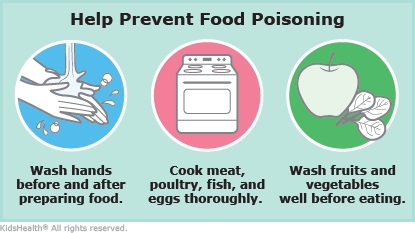
    • Before and after preparing food
    • After touching animals
  • Cook meat, poultry, fish, and eggs thoroughly. Use a meat thermometer when needed.
  • Wash cutting boards and utensils thoroughly with soap and warm water (or use a dishwasher) after preparing raw meat, fish, poultry or eggs.
  • Keep raw meat, poultry, fish (or their juices), and eggs away from other foods.
  • Wash fruits and vegetables well before eating.
  • Thaw frozen food in the refrigerator, in cold water, or in the microwave; do not thaw food at room temperature.
  • Refrigerate leftovers promptly (within two hours).
  • Don't eat food that's been left out over two hours.
  • Don't eat food that is past its expiration date.
  • Don't give honey to babies younger than 1 year old.
  • Make sure that your child's immunizations (shots) are up to date.

 When can my child return to school or daycare? It depends on the germ, but generally:

  • After being fever-free for 24 hours without fever-reducing medicine.
  • After vomiting and diarrhea have stopped for 24 hours. 

However, some types of food poisoning germs can stay in the poop and spread to others for weeks, even after a child feels better. Continue to wash hands well and often with soap and water. Ask your healthcare provider if you have any questions about your child spreading the germs.

Learn More