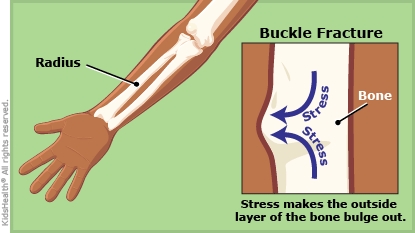
A buckle fracture happens when a bone bends and slightly buckles instead of breaking all the way through. The forearm has two bones — the radius and the ulna — that run from the elbow to the wrist. Your child has a buckle fracture in the radius.
The orthopedic specialist (bone doctor) put a cast on your child’s arm to hold it still while it heals. The cast will stay on for about 2–4 weeks. With proper care, most kids heal well from a buckle fracture.

Follow your orthopedic specialist’s instructions for:
- Any activities your child needs to avoid
- Whether your child needs to use a sling
- When to follow up
For pain and swelling:
- Prop up the wrist on pillows when your child is sitting down or sleeping.
- Remind your child to wiggle the fingers and the thumb to keep blood circulating normally.
- When your child is awake, put ice in a plastic bag wrapped in a towel on the cast for 20 minutes every three hours for up to two days. Don't put ice directly on the skin.
- If the healthcare provider said it’s OK, you can give medicine such as acetaminophen (Tylenol® or a store brand) or ibuprofen (Advil®, Motrin®, or a store brand). Follow the package directions for how much to give and how often.
Taking care of the cast:
- Don't put anything in the cast. Make sure your child doesn't put toys, food, or other objects into it.
- Keep dirt, sand, lotion, and powder away from the cast.
- If the cast is irritating your child’s skin, cover the rough or sharp part of the cast with medical tape or moleskin (available at the pharmacy without a prescription).
- If your child has itchiness under the cast, lightly tap on the cast or use a hair dryer on the cool setting to blow air in and around the edges. Don't let your child scratch under the cast or put anything into it.
- If the fingers look puffy, raise the arm above the level of the heart for one hour. If the swelling doesn't get better, call your healthcare provider.
If the cast is not waterproof, keep it dry:
- No swimming
- Younger children can get a sponge bath. For regular baths or showers, you can cover the cast with:
- Two plastic bags sealed at the top with a rubber band (or tape)
- Plastic wrap covered with a plastic bag that is sealed at the top
- A waterproof cast protector
- If the cast gets splashed, blow air into it from a hair dryer on the cool setting.
If your child has a waterproof cast:
- Your child can bathe, shower, and swim without covering the waterproof cast.
- Once a day, and after bathing, showering, or swimming:
- Flush the cast and liner with clean water.
- Dry the waterproof cast with a hair dryer on the cool or fan-only setting afterwards.

Your child’s hand becomes pale, blue, numb, tingly, or cold.

What is the radius bone? The radius is the bone on the thumb side of the arm between the elbow and wrist.
Why do kids get buckle fractures? Kids' bones are still growing and not as hard as adults' bones. If they hold out their arms to stop a fall, the pressure on the bone makes the outside layer of bone bulge out without the bone actually breaking.
What does the cast do? The cast is made of fiberglass or plaster with soft padding inside. It supports and protects the broken bone while it heals. It might feel snug, but it shouldn't feel too tight or painful. It can feel heavy, so your child might wear a sling around the neck and over the cast for support.