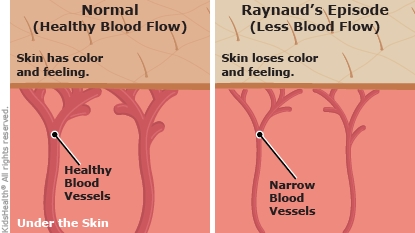
Raynaud (ray-NOH) phenomenon (also called Raynaud disease or Raynaud syndrome) causes the fingers or toes to change color for a short time. First the blood vessels narrow, so there is less blood going to the fingers or toes. This makes the area white or blue, and the fingers or toes may feel numb or tingly. Then, once the cause of Raynaud phenomenon goes away, the blood vessels open back up and blood flows into the fingers and toes, causing the areas to turn red.
A Raynaud episode is usually caused by being cold or stressed. In most kids, it's harmless and gets better as they get older.

To help prevent a Raynaud episode:
- In cold weather, have your child:
- Stay warm by wearing a coat, hat, scarf, and mittens (instead of gloves since fingers warm each other in mittens)
- Dress in layers so they can adjust to changes in temperature
- Use hand or foot warmers in pockets or shoes
- Wear thick socks
- Avoid sudden temperature changes, when possible (For example, they should avoid going from a hot shower or bath to a cold room.)
- Carry a jacket or sweater with them for use in air-conditioned areas
- Talk to your child about ways to manage stress, such as:
- Practicing meditation, deep breathing, or yoga
- Being physically active every day (This also helps with healthy circulation, which can improve Raynaud phenomenon.)
- Getting enough sleep
- Eating healthy foods
- Talking to a counselor
- Being aware that too much screen time may increase stress
- Balancing school and work activities with enough time to relax/recharge
- Help your child avoid caffeine and smoking , which can make Raynaud phenomenon worse. For help quitting smoking, call 800-QUIT-NOW (800-784-8669) or visit smokefree.gov.
If your child is having a Raynaud episode:
- Move them to a warm room.
- Have them wiggle fingers and toes gently.
- Have them rub their hands together or place their hands against a warm part of the body (such as the armpits).
- Massage their hands or feet.
- Give them a warm drink.
- Run warm (not hot) water over their hands and feet.
Other important information:
- Never use direct heat (like a heating pad) to warm your child's fingers or toes during a Raynaud episode.
- Have your child avoid wearing tight-fitting rings, bracelets, or shoes, since these can make it harder for blood to get through the blood vessels during a Raynaud episode.
- If your child takes any medicines, check with your healthcare provider to make sure they don't make Raynaud phenomenon worse.

Who gets Raynaud phenomenon? Anyone can get Raynaud phenomenon, but it is more likely to happen in people who have:
- An autoimmune disorder (when the body's germ-fighting system attacks its own cells)
- Relatives with Raynaud phenomenon
Does a person with Raynaud phenomenon always have the same skin color-changing pattern? No. The skin typically changes from white to blue/purple to red. But in some kids, all these colors may not happen, or the color changes may happen in a different order.
What other parts of the body can Raynaud phenomenon affect? Raynaud syndrome usually affects fingers and toes, but occasionally it can affect the nose, ears, lips, nipples, or knees.
How long does a Raynaud episode usually last? An episode usually will last for as long as the trigger is present. It can take about 15–20 minutes to go away after that.