Your Baby's 9-Month Checkup

Today's visit was a chance to check in on your baby's growth, development, and overall health. Here's some information to help you care for your baby in the months ahead.

Diet

  • Continue giving your baby breast milk or iron-fortified formula. Do not give cow's milk or dairy-alternative drinks that are not labeled as infant formula.
  • You can continue to breastfeed or give a bottle.
  • At mealtime, offer breast milk or formula in a cup with a lid so your baby can practice drinking from a cup. Don't use valved, no-spill cups — they work like a bottle and don't teach how to drink from a cup.
  • Offer three meals and 2–3 healthy snacks a day. Pull your baby's highchair up to the table during meals and eat together as a family as often as possible.
  • Your child is ready for thicker textures, soft lumps, and finger foods. Encourage self-feeding and offer a variety of foods, such as:
    • Iron-rich foods: iron-fortified infant cereal; pureed, ground, or soft-cooked meats; low-mercury fish (without bones) such as salmon, canned light tuna, and cod; and shrimp, eggs, mashed beans, and lentils
    • Bite-size pieces of vegetables and fruits cooked until soft, such as carrots, sweet potatoes, broccoli, apples, and pears, and bite-size pieces of soft fruits like bananas, melon, strawberries, and avocado
    • Whole-milk yogurt (without added sugar) and small pieces of soft cheese
    • Peanut or nut butter thinned with water, breast milk, or formula or soft peanut puffs made for babies 
  • Don't give your baby foods that can cause choking, such as hot dogs, whole grapes, raisins, nuts, popcorn, hard candy, gum, peanut or nut butter that hasn't been thinned, raw or hard fruits and vegetables, chunks of meat, or hard cheese.
  • Don't give your baby honey or unpasteurized food or drinks. It could make them sick.
  • Don't give juice before your baby is 12 months old. It can lead to tooth decay and too much weight gain.
  • Pay attention to signs that your baby is full, such as turning away from food, closing their mouth, or pushing food away.
  • Give any vitamin supplements as recommended by your healthcare provider.

Sleep

  • Help your baby get about 12–16 hours of sleep in a 24-hour period, including naps.
  • Have a calm bedtime routine that includes a favorite toy, reading, and quiet singing.
  • If your baby wakes at night, wait a few minutes to give them some time to settle down. If fussiness continues, go to your baby so they know you're there, but try not to pick up, play with, or feed your baby. Leave the room after about a minute so your baby can try to fall back to sleep.
  • To help prevent SIDS (sudden infant death syndrome):
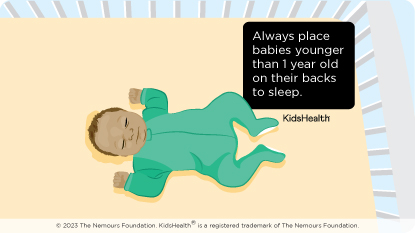
    • Always put your baby on their back for sleep.
    • Put your baby in a crib or bassinet with a firm, flat surface that meets all safety standards.
    • Never put wedges, sleep positioners, pillows, blankets, bumpers, or toys in the crib or bassinet.
    • Keep the crib or bassinet in the room where you sleep. Don't have your baby sleep in bed with you.
    • Breastfeed your baby, if possible.
    • Offer your baby a pacifier at naptime and bedtime.
    • Keep the room at a comfortable temperature. Do not overdress your baby. Watch for signs of overheating, such as sweating.
    • If your baby falls asleep in a car seat, stroller, sling, or baby carrier, move them to the crib or bassinet as soon as possible.
    • Don't let anyone smoke around your baby. Make your home and car smoke- and vapor-free. For help quitting, call 800-QUIT-NOW (800-784-8669) or visit smokefree.gov.
    • Make sure everyone who cares for your baby follows these safe sleep practices.

Always place babies younger than 1 year old on their backs to sleep.

Development

  • Babies this age learn best by talking and playing with others and touching things in their world. It is best to avoid screen time, including videos, video games, TV, and phone apps. Video chatting (such as FaceTime or Zoom) is OK.
  • Your baby may start to get upset when you leave them with a caregiver. To help your baby understand that you will return, keep goodbyes short and calm and tell your baby you will be back. Your baby may be upset at first, but they will likely calm down after you leave.
  • Get all immunizations (vaccines) and tests that your baby's healthcare provider recommends.
  • Take care of your baby's teeth and gums:
    • If recommended, give your baby fluoride drops at home.
    • If your baby has teeth, brush them once a day using a soft toothbrush with a smear of fluoride toothpaste (about the size of a grain of rice).
    • If your baby is thirsty between meals, offer a bottle or cup (sippy or regular) filled with water only. Do not give your baby bottle or cup in the crib.
    • If your baby has sore gums from teething, try rubbing the gums with one of your fingers or give your baby a firm rubber teething ring. Don't use frozen teethers or medicines that you rub on the gums.

Safety

  • Put your baby in a rear-facing car seat in the back seat. Follow the manufacturer's instructions on installing and using the car seat or go to a child safety seat check (cert.safekids.org/get-car-seat-checked).
  • Make your home safe:
    • Put gates at the top and bottom of stairs.
    • Put window guards on windows above the first floor.
    • Don't use a baby walker. They can lead to serious injuries.
    • Move your baby's crib mattress to the lowest position. If your baby still has a mobile, take it down.
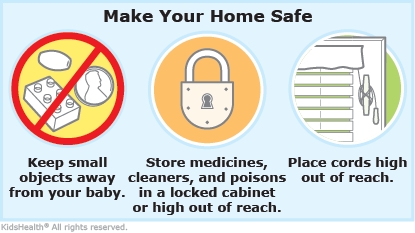
    • Store medicines, cleaning solutions, and poisons high out of reach in a locked cabinet. Get help online at poison.org or call 800-222-1222 if you are worried about a possible poisoning.
    • To prevent burns, set your water heater lower than 120°F (48°C) and don't drink hot liquids while holding your child.
    • Put smoke and carbon monoxide alarms near all sleeping areas and on every level of your home.
    • Don't let anyone smoke around your baby. Make your home and car smoke- and vapor-free. For help quitting, call 800-QUIT-NOW (800-784-8669) or visit smokefree.gov.
    • To prevent choking, keep balloons and small objects, such as coins, button batteries, and toys, away from your child
    • To prevent suffocation, keep plastic bags and drapery/blind cords away from your child.
  • Be sure you know what to do if your child is choking. If you haven't taken an infant first aid/CPR class, sign up for an online or in-person class at redcross.org.
  • Keep your child within reach if there is water nearby, including tubs, toilets, buckets, and pools. Empty the water from tubs, buckets, and child pools when you're finished using them.
  • Protect your child from the sun by keeping them in the shade and dressing them in a long-sleeved shirt and long pants, a wide-brimmed hat, and sunglasses when outside. If needed, you can use a water-resistant, mineral-based sunscreen with an SPF (sun protection factor) of at least 30 that protects skin from both UVA and UVB rays.
  • Never shake your baby — it can cause bleeding in the baby's brain and even death. If you are ever worried that you will hurt your baby, put your baby in the crib or bassinet for a few minutes so you can get help. See below for ways to get help.

Illustration should three major ways to babyproof your home.

  • Your baby:
    • Has a rectal (in the bottom) temperature of 100.4°F (38°C) or higher
    • Gets a rash, vomits, or has any reaction to a food
    • Has hard, dry poop or trouble pooping
    • Doesn't seem to be growing or developing normally
  • You are struggling with food, housing, healthcare costs, or substance use. 

If you are feeling very overwhelmed, anxious, or sad, have thoughts about hurting yourself or your baby, or see or hear things that aren’t there, put your baby safely in a crib or bassinet and get help right away.

Where to get help:

  • Call Postpartum Support International at 800-944-4773 or visit postpartum.net. You can also text HELP to 800-944-4773 (English) or 971-203-7773 (Spanish).
  • Call or text 988 or visit 988lifeline.org (Suicide & Crisis Lifeline). You can also go to the nearest emergency room.
  • Text HOME to 741741 (National Crisis Text Line).
Learn More