Your Baby's 2-Month Checkup

Today's visit was a chance to check in on your baby's growth, development, and overall health. Here's some information to help you care for your baby in the months ahead.

  • Feed your baby when they show signs of hunger, such as smacking their lips, making sucking motions, looking around for your breast or the bottle, or crying.
  • Pay attention to signs that your baby is full, such as turning away from the breast or nipple and closing their mouth.
  • Do not give your baby water, juice, or solid foods (such as baby cereal) unless your healthcare provider recommends it.
  • If you are breastfeeding:
    • Your baby should breastfeed about every 1.5–3 hours, or 8–12 times per day. Breast milk is digested quickly, so frequent feeding is completely normal.
    • Give your baby 400 IU of vitamin D drops every day unless your healthcare provider told you otherwise.
  • If you are formula feeding:
    • Offer your baby about 4–5 ounces (120–150 ml) of formula every 3–4 hours. Tell your healthcare provider if your baby usually wants to drink more than 32 ounces (960 ml) of formula a day.
    • Don't give your baby low-iron formula.
    • Don't add extra water to your baby's formula.
    • Never prop up the bottle — always hold your baby during feedings.

  • Your baby should have at least six wet diapers a day. 
  • Breastfed babies may poop many times a day, only once a week, or anywhere in between. Formula-fed babies usually poop at least once a day. As long as the poop is soft and your baby seems well, don't worry about how often your baby poops.

Sleep

  • Babies this age sleep about 14–17 hours in 24 hours, including several daytime naps. Some babies sleep four or five hours in a row at night, but many still wake up more often to breastfeed or take a bottle.
  • Put your baby in the crib when they're sleepy but not yet asleep. This helps babies learn to fall asleep on their own.
  • To help prevent SIDS (sudden infant death syndrome):
    • Always put your baby on their back for sleep.
    • Put your baby in a crib or bassinet with a firm, flat surface that meets all safety standards.
    • Never put wedges, sleep positioners, pillows, blankets, bumpers, or toys in the crib or bassinet.
    • Keep the crib or bassinet in the room where you sleep. Don't have your baby sleep in bed with you.
    • Breastfeed your baby, if possible.
    • Offer your baby a pacifier at naptime and bedtime.
    • Keep the room at a comfortable temperature. Do not overdress your baby. Watch for signs of overheating, such as sweating.
    • If your baby falls asleep in a car seat, stroller, sling, or baby carrier, move them to the crib or bassinet as soon as possible.
    • Don't let anyone smoke around your baby. Make your home and car smoke- and vapor-free. For help quitting, call 800-QUIT-NOW (800-784-8669) or visit smokefree.gov.
    • Make sure everyone who cares for your baby follows these safe sleep practices.

Development

  • Talk, read, sing, and play with your baby every day.
  • To help your baby's muscles get stronger, put your baby on their belly for “tummy time.” Do this 2–3 times a day for 3–5 minutes when your baby is awake. Build up to more tummy time as long as your baby doesn't get frustrated. Be sure an adult stays with your baby during tummy time.
  • It's normal for babies to be fussy at times, especially in the first 2–3 months of age. Babies usually cry less when they reach 3 or 4 months.
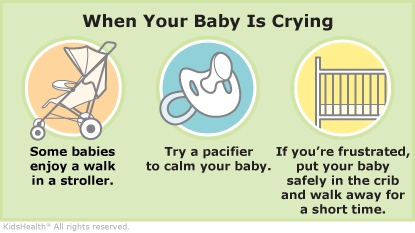
  • Try these ways to calm your baby:
    • Rock or hold your baby while you walk.
    • Sing or play music.
    • Turn on a fan or other calming noise.
    • Give your baby a pacifier.
    • Rub your baby's back while they're lying across your knees.

Illustration of three callouts with suggestions for soothing your crying child.

Routine Care

  • Get all immunizations (vaccines) and tests that your baby's healthcare provider recommends.
  • Bathe your baby a few times a week in a sink or infant tub lined with a towel. Use warm water and fragrance-free soap. Always keep your eyes and a hand on your baby during a bath.

Safety

  • In the car, put your baby in a rear-facing car seat in the back seat. Follow the manufacturer's instructions on installing and using the car seat or go to a child safety seat check (cert.safekids.org/get-car-seat-checked).
  • If you haven't taken an infant first aid/CPR class, sign up for an online or in-person class at redcross.org.
  • To prevent burns, set your water heater lower than 120°F (48°C).
  • Put smoke and carbon monoxide alarms near all sleeping areas and on every level of your home.
  • When using a changing table, keep a hand on your baby and use the safety buckle.
  • To prevent choking or suffocation, keep small objects, plastic bags, and balloons away from your baby.
  • It is best not to use sunscreen on babies younger than 6 months, but you may use a small amount if shade and clothing don't give enough protection. 
  • Never shake your baby — it can cause bleeding in the baby's brain and even death. If you are ever worried that you will hurt your baby, put your baby in the crib or bassinet for a few minutes so you can get help. See below for ways to get help.

  • Your baby:
    • Has a rectal (in the bottom) temperature of 100.4°F (38°C) or higher 
    • Is too sleepy or weak to feed well
    • Has hard, dry poop or trouble pooping
    • Doesn't seem to be growing or developing normally
  • You are struggling with food, housing, healthcare costs, or substance use.

Go to the ER if...

Your baby:

  • Has a rectal (in the bottom) temperature of 100.4°F (38°C) or higher and you can’t reach your healthcare provider, or your baby isn’t feeding well or seems very ill
  • Vomits more than a few times in a 24-hour period or has green vomit

If you are feeling very overwhelmed, anxious, or sad, have thoughts about hurting yourself or your baby, or see or hear things that aren’t there, put your baby safely in a crib or bassinet and get help right away.

Where to get help:

  • Call Postpartum Support International at 800-944-4773 or visit postpartum.net. You can also text HELP to 800-944-4773 (English) or 971-203-7773 (Spanish).
  • Call or text 988 or visit 988lifeline.org (Suicide & Crisis Lifeline). You can also go to the nearest emergency room.
  • Text HOME to 741741 (National Crisis Text Line).
Learn More