After Joint Aspiration: How to Care for Your Child

A joint is where two bones meet in the body (for instance, the elbows, knees, shoulders, hips, and wrists). The area inside the joint contains a liquid, called synovial fluid. This fluid cushions the bones and helps them move easily.

The healthcare provider did an joint aspiration (also called an arthrocentesis) on your child's joint, which means they removed some of the synovial fluid. Taking out the synovial fluid can relieve joint swelling or pain. The healthcare provider will send the synovial fluid for testing to see what's causing the swelling or other issues.

Here's how to care for your child after the procedure.
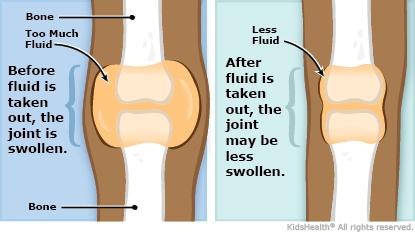
Illustration comparing a joint before and after fluid has been removed.

Care Instructions

  • If your child had medicine to relax or sleep during the procedure, they may need to rest for a few hours afterward.
  • Follow your healthcare provider's instructions for:
    • Giving your child any pain medicines, such as acetaminophen (Tylenol® or a store brand) or ibuprofen (Advil®, Motrin®, or a store brand). Follow the package directions for how much to give and how often.
    • Putting ice wrapped in a towel on the area for about 20 minutes a few times a day.
    • When it's OK to take off the bandage.
    • Any stretching or strengthening exercises your child should do.
    • When your child can bathe.
    • When your child can go back to regular activities and sports.
    • When to call or make a follow-up appointment to talk about the test results.

Your child:

  • Has a lot of pain, even after taking the pain medicines as directed
  • Has new or worsening redness, pain, or swelling around the joint
  • Gets a fever
  • Has a lot of drainage or bleeding in the area where the joint aspiration was done

Go to the ER if...

Your child:

  • Has severe pain
  • Can't move the joint

More to Know

Why do healthcare providers do joint aspirations? They do them to:

  • Relieve joint swelling and pain
  • Find out what is causing a joint problem
  • Decide on a treatment plan for the joint problem
Learn More

