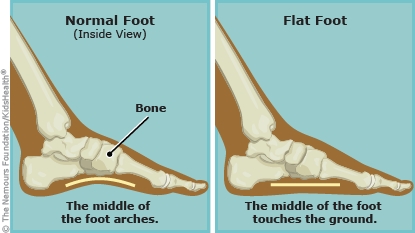
Flat feet are feet that do not have an arch. The middle of the foot touches the ground. Flat feet don't usually need treatment. But if pain or other problems develop, treatments can help.

Follow your healthcare provider's recommendations for:
- What shoes your child should wear and if they need any shoe inserts to support the arch.
- Any activities or sports your child should avoid.
- Whether it's OK for your child to walk barefoot.
- If your child needs to do any strengthening exercises or stretches.
- If your child needs to see any specialists such as a physical therapist or orthopedic specialist (a healthcare provider who treats bone and joint problems).
- Whether it's OK to give acetaminophen (Tylenol® or a store brand) or ibuprofen (Advil®, Motrin®, or a store brand) if your child has pain. Follow the package directions for how much to give and how often.
- When to follow up.

What are the different types of flat feet? There are two kinds of flat feet:
- Flexible flat feet: There's no arch when the person walks, but there is an arch when they sit or stand on their tiptoes.
- Rigid flat feet: There's no arch when the person walks, sits, or stands on tiptoes.
What causes flat feet? Most babies and toddlers have flat feet. As they grow, an arch usually develops. But in some people, the arch doesn't form.
Flat feet also can result from:
- Tight Achilles tendons (a tendon on the back of your heel)
- Muscle problems
- Problems with how bones in the feet formed
Children with some kinds of genetic disorders (such as Down syndrome or osteogenesis imperfecta, an inherited brittle bone disease) also can have flat feet. Flat feet can run in families.