Fever: How to Care for Your Child, Age 3 Years and Older

Your child had a fever (a higher-than-normal body temperature). Fevers in kids are usually caused by an infection. A fever helps the body’s immune system fight the infection.

Your child stayed in the hospital for testing and treatment. Your child is feeling better and can be cared for at home. At this time, a specific cause wasn't found for your child's fever.

It's important to know if your child's fever has returned, gets higher, or if they have any new or worsening symptoms. This may mean they need other treatment.

Care Instructions

  • Give your child any medicines as instructed by your healthcare provider.
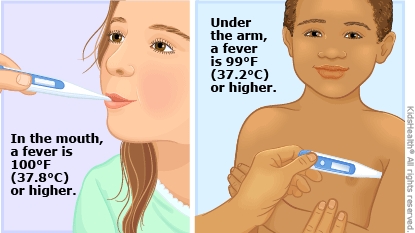
  • If your child feels warm, take their temperature. If your child can hold the thermometer in their mouth (typically by about 4–5 years old), it's best to take an oral temperature since this gives the most reliable reading. You may also take an axillary (under the arm), temporal artery (across the forehead), or tympanic (in the ear) temperature.
  • Use this chart to see if your child has a fever:
Type of Measurement Where to Take the Temperature When is the temperature a fever?
Oral Mouth 100°F (37.8°C) or greater
Axillary Armpit 99°F (37.2°C) or greater
Temporal Artery Forehead 100.4°F (38.0°C) or greater
Tympanic Ear 100.4°F (38.0°C) or greater

  • If your child has a fever, keep a record of the temperature on paper or on your phone.
  • Do not use a glass thermometer with mercury because these are not safe.
  • If your child is uncomfortable from the fever, and your healthcare provider says it's OK, you can give acetaminophen (Tylenol® or a store brand) or ibuprofen (Advil®, Motrin®, or a store brand). Follow the package directions for how much to give and how often.
  • Don't give your child aspirin. It can cause Reye syndrome, a rare but serious illness.
  • Offer your child plenty of liquids to drink.
  • Let your child rest as needed.
  • Your child may return to childcare or school after the fever has been gone for 24 hours without the use of fever-reducing medicine (such as acetaminophen or ibuprofen).

Your child:

  • Is drinking very little
  • Gets a new fever after the fever went away, still has a fever after 2–3 days, or has a higher fever
  • Develops new or worsening symptoms, such as vomiting (throwing up) or diarrhea, cough or congestion, rash, pain when urinating (peeing), belly pain, ear pain, or a sore throat
  • Seems to be getting sicker

Go to the ER if...

Your child:

  • Isn't drinking at all or has signs of dehydration (not enough water in the body), such as a dry or sticky mouth, sunken eyes, less pee or darker pee than usual, little or no tears when crying, or unusual sleepiness
  • Is very upset or is crying nonstop and can't be calmed down
  • Develops a severe headache, stiff neck, or a rash, bruising or red dots on the skin, fast breathing, or trouble swallowing (These can all be signs of a serious infection.)
  • Has a seizure (uncontrolled body movements)

You know your child best. If they have symptoms that worry you or seem very sick, call your healthcare provider or take your child to the ER.

More to Know

What causes fever? Fever in kids is usually caused by an infection from a virus (a type of germ). For example, a cold, stomach bug, and cough are usually caused by a virus. An infection from bacteria (another type of germ) can also cause a fever. Ear and sinus infections can be caused by bacteria. Infections caused by bacteria are treated with antibiotics. Antibiotics don't treat viruses. Sometimes it's not exactly clear what caused a fever in a child.

What are the symptoms of a fever? Kids with a fever may be fussy, cranky, or quieter than usual, or have a headache, chills, sweating, or red skin.

If my child feels warm, is it always a fever? Not all kids who feel warm have a fever, so it's best to use a thermometer to measure their temperature if you have any concerns. Kids can feel warm when they are very active, play outdoors in hot weather, sleep in warm pajamas under blankets, or are upset and crying. These things make the skin feel hot because the skin is doing its job of getting rid of heat in the body.

Learn More