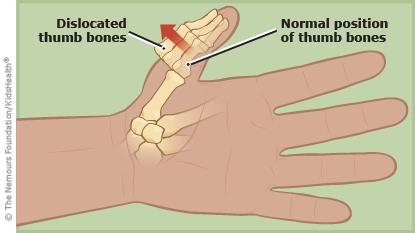
A dislocated thumb happens when the bones of the thumb slip out of place. It's treated by placing the thumb in a splint. Your child will have a splint for a few weeks while the thumb heals. Most kids who dislocate a thumb can gradually return to their normal activities. After healing, the thumb may feel sore or stiff for a while.

For swelling:
- For the next few days, put a cold pack or plastic bag of ice wrapped in a towel on the thumb for 15–20 minutes three or four times a day. Do not place ice directly on the skin or splint.
- Help your child keep the hand raised above heart level as often as possible. Try propping it up with pillows.
- If your child was given a sling (a sleeve to hold the arm up) to help with swelling, use it as directed. Don't let your child sleep in the sling.
For pain:
If your child is uncomfortable, a pain medicine can help. If the health care provider says it's OK, give acetaminophen (such as Tylenol® or a store brand) OR ibuprofen (such as Advil®, Motrin®, or a store brand) exactly as directed. Don't give ibuprofen to babies under 6 months old.
Daily care for the splint:
- Do not try to remove the splint or adjust it unless your health care provider told you to do so.
- Check the area around the splint. Make sure the skin isn't scratched, and the thumb and fingers aren't pale, blue, numb, or tingling.
- Make sure your child doesn't pick or scratch under the splint.
- Don't put anything in the splint. Make sure your child doesn't put toys, food, or anything else into it.
- Keep dirt, sand, lotion, and powder away from the splint.
- Keep the splint dry:
- Put a plastic covering over the splint when your child bathes.
- If the splint gets splashed with water, gently blow air onto it from a hair dryer on the cool setting.
Follow-up:
- Schedule a follow-up visit with the orthopedic doctor (bone specialist) as directed. Sometimes they will change the splint to a cast.
- Ask your health care provider when it's OK for your child to return to sports. They might recommend protective hand gear or taping for sports play.

How does a dislocated thumb happen? A thumb dislocation may happen from a fall, blow, or sports injury, especially if the thumb is bent back or jammed.
Can a dislocated thumb happen again? Yes. A joint that dislocated once is more likely to dislocate again.