
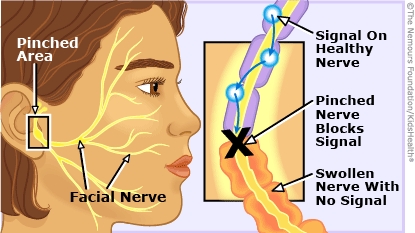
Bell's palsy is a sudden weakness on one side of the face that happens when there is a problem with the facial nerve. This weakness makes it hard for your child to move their mouth, raise their forehead and eyebrow, wrinkle their nose, or close their eye on that side of the face. This can make your child's face look stiff or droopy.
Bell's palsy usually gets better on its own. Here's how to care for your child.

Follow your healthcare provider's instructions for:

Your child:

What causes Bell's palsy? Usually, healthcare providers don't know exactly why Bell's palsy happens. Sometimes an injury such as a hit to the face or head can injure the facial nerve. Other times, the swelling is caused by germs from a virus (such as herpes or the flu) or bacteria from other illnesses (such as Lyme disease or an ear infection).
How long does Bell's palsy last? It may get worse over the first few days before it starts to get better. Most kids with Bell's palsy will begin to improve in the first 3 weeks and get completely better in 1–6 months. Rarely, some kids will continue to have a little facial weakness after this time.
Will my child have any other symptoms or problems? Along with trouble moving their face, some kids with Bell's palsy can have a dry eye, trouble closing their eye, or trouble chewing or tasting their food. They can also be more sensitive to sounds.
Bell's palsy can be hard for kids because it affects their appearance. Reassure your child that their face will soon get better. Explaining that it's a medical problem that isn't contagious can be helpful if people ask what's wrong or say unkind things.
What medicines may be prescribed? Doctors might prescribe steroid medicines to ease nerve swelling, especially in the first 3 days, along with eye drops or ointment to lubricate and protect the eye.

