Erythema Nodosum: How to Care for Your Child

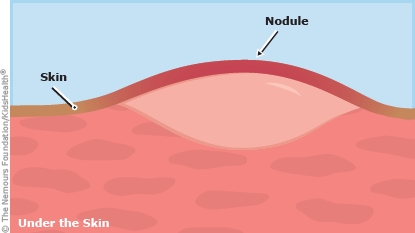
Erythema nodosum (air-uh-THEE-muh noh-DOH-sum) is a skin condition that causes painful, tender lumps to develop under the skin, most often on the front of the lower leg (the shins). These lumps, called nodules, are red or purple and feel warm to the touch. Some kids with erythema nodosum also have a fever, and achy joints or muscles.

Erythema nodosum almost always goes away on its own, though it can take several weeks to a few months. Here's how to keep your child comfortable.

Care Instructions

To help with pain and swelling:

  • If your healthcare provider says it's OK, give acetaminophen (Tylenol® or a store brand), ibuprofen (Advil®, Motrin®, or a store brand), or naproxen (Aleve®, Naprosyn®, or a store brand). Follow the package directions for how much to give and how often.
  • Apply a cool, moist cloth (compress) to the affected areas for 15–20 minutes at a time, several times a day. (Do not use heating pads or hot compresses, as heat can make the pain and swelling worse.)
  • Have your child wear compression socks or support stockings if it helps them feel more comfortable.

Activity:

  • If activities like running and jumping cause discomfort, your child should take a break from those activities. They can try a less vigorous activity like walking or swimming. 
  • As the nodules start to fade and become less tender, your child can slowly increase their activity level. Let pain be the guide — if an activity hurts, it's too soon. They can take a break and try the activity again in a few days.
  • Have your child put their legs up on pillows when sitting or lying down to lessen pain and swelling.

General care:

  • Sometimes a medicine can cause erythema nodosum. Follow your healthcare provider's instructions for stopping or avoiding any medicines.
  • You and your child should not squeeze or pick at the nodules. They are not pimples and should be left alone to heal.
  • Have your child wear loose, comfortable clothing that doesn't rub against the nodules.
  • Follow your healthcare provider's recommendations for:
    • When to follow up
    • Taking your child for any testing
    • Taking your child to see any medical specialists

  • The nodules are getting worse, spreading, or new ones are appearing after the first week.
  • The pain is not controlled with the recommended medications.
  • Your child has new or worsening symptoms, such as fever, joint pain, cough, belly pain, diarrhea, blood in their poop, or extreme tiredness.
  • The nodules have not started to improve after 2–3 weeks.
  • The skin over a nodule breaks open, starts draining, or shows signs of infection (increased redness, warmth, pus, or red streaks).

More to Know

What causes erythema nodosum? Erythema nodosum happens when the immune system (the body's system that fights germs) is triggered by an infection (such as strep throat or a viral illness), medicine, or a medical condition. The immune system releases cells that lead to inflammation (pain and swelling) of the fat tissue under the skin, usually appearing on the shins.

How long will the nodules last? Most nodules begin to improve within 2–3 weeks, but it can take 6–8 weeks (or sometimes longer) for them to completely fade. The nodules will go through color changes — from red or purple to a bruise-like brown or yellow — before disappearing.

Will the nodules leave scars? No. Erythema nodosum does not cause permanent scarring. The skin may look discolored for a while as it heals, but this will fade over time.

Can erythema nodosum come back? It can, but it's not common. If it does, it often has the same trigger as the first time.

Can my child go to school or daycare? Yes, as long as your child feels well enough. Erythema nodosum is not contagious. However, if the nodules are very painful or your child is having trouble walking, they may need to stay home until they feel more comfortable.

Learn More
