After a Spinal Tap: How to Care for Your Child

A lumbar puncture, or spinal tap, is a medical test that involves collecting a small sample of cerebrospinal fluid (CSF) for examination. Cerebrospinal fluid (also called spinal fluid) is a liquid that helps "cushion" the brain and spinal cord.

Your child had a spinal tap and is now ready to go home. The healthcare provider may have given your child medicine so they could relax during the procedure, so they may be a little sleepy. Your child may have a mild headache or feel some discomfort on their back where the spinal tap was done. These symptoms should go away within a few hours of the spinal tap.
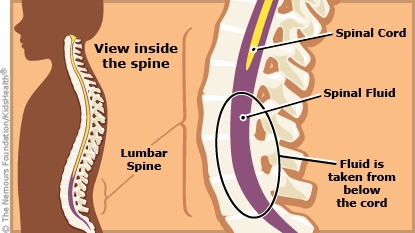

Care Instructions

  • Allow your child to rest as much as needed.
  • If your child has a mild headache or back pain and your healthcare provider says it's OK, you can give acetaminophen (Tylenol® or a store brand) or ibuprofen (Advil®, Motrin®, or a store brand). Don't give ibuprofen to babies under 6 months old. Follow the package directions for how much to give and how often.
  • Don't give aspirin to your child. It can cause a rare but serious illness called Reye syndrome.
  • Make sure your child drinks plenty of fluids.
  • Follow up as instructed by your healthcare provider.

Your child:

  • Is getting more irritable (fussy)
  • Has a headache or back pain that lasts more than a few hours after the spinal tap or that seems to be getting worse
  • Develops new symptoms, such as a fever, vomiting, or pain in the legs

Go to the ER if...

Your child:

  • Has redness, swelling, pain, or bleeding on the back where the spinal tap was done
  • Has numbness or weakness in the legs or has trouble walking

More to Know

Why do healthcare providers do a spinal tap? Healthcare providers do a spinal tap to:

  • Look for an infection (called meningitis) of the covering around the brain and spinal cord 
  • Test for bleeding in the brain
  • Lower pressure in the brain
  • Give medicine 
  • Put dye into the cerebrospinal fluid for certain tests
