Influenza: How to Care for Your Child

Influenza, also known as "the flu," is an infection caused by a virus. Your child stayed in the hospital for care and is now ready to go home. Most kids with the flu feel better in about a week, but some feel tired and weak for a few weeks after having the flu.

The flu can cause serious medical problems, especially in young children and in children with other medical conditions (such as asthma, HIV, or diabetes). Getting the flu vaccine every year helps protect kids from the flu.
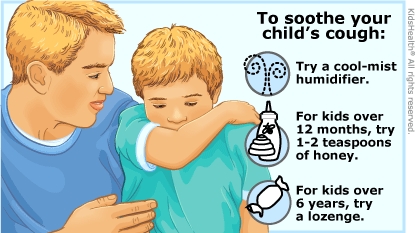

Illustration of a father consoling a child who is coughing with three callouts on how to soothe your child's cough.

Care Instructions

  • Follow your healthcare provider's instructions for giving any prescribed medicines.
  • If your healthcare provider says it's OK, you can give acetaminophen (Tylenol® or a store brand) or ibuprofen (Advil®, Motrin®, or a store brand) for fever, sore throat, or body aches. Follow the package directions for how much to give and how often.
  • Do not give ibuprofen to babies under 6 months old.
  • Do not give aspirin to your child or teen. It can cause a rare but serious illness called Reye syndrome.
  • Do not give cough or cold medicines to children under 6 years old because they can cause bad reactions. Only give these medicines to children over 6 years old if your healthcare provider says it's OK.
  • Let your child rest as needed.
  • Offer your child plenty of liquids. Babies can continue to breastfeed or take formula.
  • To soothe your child's cough:
    • Run a cool-mist humidifier in your child's bedroom. Clean it after each use.
    • If your child is older than 12 months, it's OK to give 1–2 teaspoons of honey at night. If your child is under 12 months old, do not give honey.
    • If your child is over 6 years old, you can offer a lozenge or cough drop. To prevent choking, make sure your child is sitting up and awake and that an adult is nearby.
  • To help with a runny or stuffy nose:
    • Run a cool-mist humidifier in your child's bedroom. Clean it after each use.
    • For babies: Put a few drops of saline (saltwater) into the nose, then gently suction the mucus out with a bulb syringe. Do this no more than 2–3 times a day so that the inside of your baby's nose does not get swollen or sore.
    • For older kids: Give 2 sprays of saline nose spray 3 times a day.
  • Your child can return to school and activities when they feel better and haven't had a fever for 24 hours without using a fever-reducing medicine (such as acetaminophen or ibuprofen). Check with your healthcare provider if you're not sure whether your child is ready to return to school and activities.

Your child:

  • Has new or worsening symptoms (such as fever, cough, headache, or ear pain)
  • Does not feel better in 3–4 days or is getting sicker

Go to the ER if...

Your child:

  • Isn't drinking at all or has signs of dehydration (not enough water in the body), such as a dry or sticky mouth, sunken eyes, less pee or darker pee than usual, little or no tears when crying, or unusual sleepiness
  • Has trouble breathing; signs include fast breathing, the muscles pulling in between the ribs, or the nose puffing out with each breath
  • Gets a stiff neck
  • Seems very sleepy or confused

You know your child best. If they have symptoms that worry you or seem very sick, call your healthcare provider or take your child to the ER.

More to Know

How does the flu spread? The flu spreads easily from person to person. It can spread when a person with the flu coughs and/or sneezes the virus into the air and someone else breathes it in. It also can spread when someone touches the influenza virus on another person or a hard surface (such as a doorknob), then touches their own eyes, nose, or mouth.

Your child may still spread influenza up to 10 days after getting sick. To help reduce the spread of influenza and other viruses, teach kids to:

  • Sneeze into a tissue, if possible, then throw the tissue away and wash their hands well. If a tissue is not available, they should sneeze into their upper sleeve or inner elbow, not their hands.
  • Wash hands well and often with soap and water and scrub for at least 20 seconds. This is especially important after coughing or sneezing. If soap and water are not available, they can use a hand sanitizer with at least 60% alcohol.

How can we prevent the flu? The best way to prevent the flu is to get the flu vaccine every year. Although a child who gets the flu vaccine still might get the flu, the illness is likely to be less serious.

Learn More