
Your child has a fever (a higher-than-normal body temperature). Fevers in kids are usually caused by an infection. Most fevers go away in a few days.
It’s important to know how to check if your child's fever is getting higher, has come back after being gone, or if they have any new or worsening symptoms. This may mean your child needs other treatment.
Here's how to care for your child.
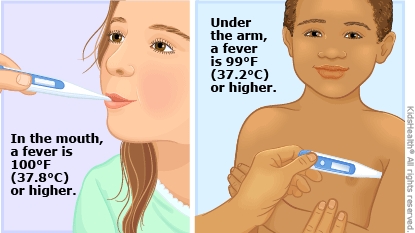

| Type of Measurement | Where to Take the Temperature | When is the temperature a fever? |
| Oral | Mouth | 100°F (37.8°C) or greater |
| Axillary | Armpit | 99°F (37.2°C) or greater |
| Temporal Artery | Forehead | 100.4°F (38.0°C) or greater |
| Tympanic | Ear | 100.4°F (38.0°C) or greater |

Your child:

Your child:
You know your child best. If they have symptoms that worry you or seem very sick, call your healthcare provider or take your child to the ER.

What causes fever? Fever in kids is usually caused by an infection from a virus (a type of germ). For example, a cold, stomach bug, and cough are usually caused by a virus. An infection from bacteria (another type of germ) can also cause a fever. Ear and sinus infections can be caused by bacteria. Infections caused by bacteria are treated with antibiotics. Antibiotics don’t treat viruses. Sometimes it’s not exactly clear what caused a fever in a child.
What are the symptoms of a fever? Kids with a fever may be fussy, cranky, or quieter than usual, or have a headache, chills, sweating, or red skin.
If my child feels warm, is it always fever? Not all kids who feel warm have a fever, so it's best to use a thermometer to measure their temperature if you have any concerns. Kids can feel warm when they are very active, play outdoors in hot weather, sleep in warm pajamas under blankets, or are upset and crying. These things make the skin feel hot because the skin is doing its job of getting rid of heat in the body.

