Absence Seizures: How to Care for Your Child

Children who have absence seizures look like they are staring into space. They may open and close their lips loudly or make chewing motions, rub their fingers together, or flutter their eyelids. After the seizure, the child has no memory of the seizure.

Absence seizures are treated with medicine. A neurologist (a doctor who specializes in problems of the brain and spinal cord) can help you find the best treatment for your child.
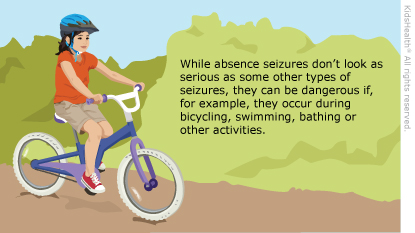

Illustration of a child riding a bicycle

Care Instructions

Follow your healthcare provider’s instructions for:

  • Any medicines your child should take
  • If any "triggers" (such as fever, lack of sleep, or medicines) can make a seizure more likely
  • Precautions your child should take to prevent drowning such as:
    • Never swimming alone
    • Taking showers only, no baths, and keeping the bathroom door unlocked)
  • Whether it’s OK for your child to ride a bike or drive a car
  • When to follow up
  • Whether your child needs to wear a medical alert bracelet

If your child has an absence seizure:

  • Speak softly during the seizure.
  • Don't shake your child or try to get their attention.
  • If your child is walking, gently place your hands on their shoulders from behind to prevent injury.
  • Stay with your child during the seizure. If the seizure lasts more than five minutes, stay with your child and ask someone else to call 911.

Share this information with caregivers, coaches, and staff at your child’s school.

Your child has more seizures than usual or seizures that seem different.


  • Your child has a seizure with jerking movements of the whole body.
  • If your child has a seizure lasting more than five minutes or has repeated seizures.

More to Know

What happens during a seizure? The brain works using electrical signals. A seizure is a sudden increase in these electrical signals. A seizure that affects both sides of the brain is called generalized. A seizure that involves only one side of the brain is called focal. An absence seizure is a type of generalized seizure.

What causes absence seizures? Many times, the cause of absence seizures is not known. Sometimes seizures are from genetic changes (mutations). Children with absence seizures usually have a relative who has seizures too.

What problems can happen? Absence seizures usually get better with medicine. And with medicine, about 60% of children outgrow absence seizures in their teens. Without medicine, absence seizures can get worse and may affect learning, development, or behavior.

How can parents help their child get the best treatment? Be sure your child follows the healthcare provider's recommendations. If your child has another seizure, keep a record of:

  • When it happened
  • How long it lasted
  • What happened right before the seizure
  • What happened during and after the seizure

This information will help the healthcare provider find the best treatment for your child's seizures.

Learn More