Croup: How to Care for Your Child

Children with croup have a virus (a type of germ) that makes their airways swell. They have a barky cough and a raspy voice. Some kids with croup also have stridor, a high-pitched, squeaky noise that happens during breathing.

Your child stayed in the hospital for treatment. They are now ready to go home. Follow these care instructions to help your child continue to feel better.
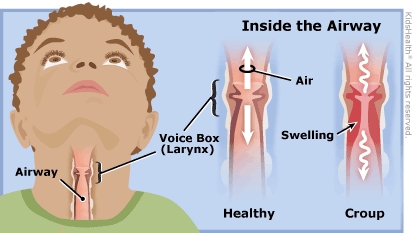

Illustration of how croup effects the airway

Care Instructions

  • Give your child any medicines that your healthcare provider prescribed.
  • Try to keep your child calm. Crying can make croup worse.
  • If your child coughs a lot, these things might help:
    • Run a hot shower to fill the bathroom with steam. Help your child breathe in the steam. (Don't take your child into the hot shower.)
    • If the weather is cool, open a window or a door and let your child breathe in the cool, outdoor air.
  • Try using a cool-mist humidifier, especially when your child is sleeping. Clean the humidifier after each use. Tap water contains minerals. When possible, use distilled water to run and clean the humidifier.
  • Give your child plenty of liquids. If needed, give small amounts of liquid often, using a spoon or a medicine dropper.
  • Fever can make your child feel worse. If your child has a fever, and your healthcare provider says it's OK, you can give acetaminophen (Tylenol® or a store brand) or ibuprofen (Advil®, Motrin®, or a store brand). Follow the package directions for how much to give and how often. Don't give ibuprofen to babies under 6 months old. 
  • Don't give your child aspirin. It can cause Reye syndrome, a rare but serious illness.
  • Don't give cough or cold medicines to children under 6 years old. These medicines can cause serious side effects. Check with your healthcare provider before giving cough or cold medicines to children 6 years and older.
  • Smoking/vaping and being around smoke/vapor can make your child cough more and cause many health problems. Make your home and car smoke- and vapor-free. For help quitting, call 800-QUIT-NOW (800-784-8669) or visit smokefree.gov.
  • Your child can go back to school or childcare when the cough is getting better and there's been no fever for at least 24 hours.
  • Follow up with your healthcare provider as recommended.

Your child:

  • Still has a barky cough or a raspy voice a week after symptoms started
  • Still has stridor when active or crying a week after symptoms started
  • Has a new or higher fever
  • Makes a "whoop" sound when breathing in at the end of the cough
  • Is drinking less than usual and shows signs of dehydration (not enough water in the body), such as a dry or sticky mouth, sunken eyes, peeing less often, darker than usual pee, or crying with little or no tears

Your child:

  • Has severe coughing spells that make it hard for them to catch their breath
  • Has stridor that is getting worse or that happens when sitting, resting, or sleeping
  • Is drooling
  • Has retractions — when the skin between or above the ribs retracts (pulls in) during breathing
  • Isn't drinking any liquids

Call 911 if your child is struggling to breathe, is too out of breath to talk or walk, or turns blue.

More to Know

Can croup spread to others? The viruses that cause croup can spread from one person to another. To help prevent the spread of viruses:

  • Teach children to cough or sneeze into a tissue or into their elbow or upper arm (not their hands).
  • Make sure all family members wash their hands well and often, using soap and water. They should scrub for at least 20 seconds, rinse, and dry thoroughly. This is especially important after coughing or sneezing and before eating or preparing food. If soap and water are not available, use a hand sanitizer with at least 60% alcohol.
  • Clean tabletops, doorknobs, and other hard surfaces with a cleaner that kills viruses.

Can my child get croup again? Some kids can have croup more than once. If this happens, healthcare providers can treat it. Sometimes a child who gets croup again will see an ear, nose, and throat specialist.

Learn More
