Strep Throat: How to Care for Your Child

Kids with strep throat have a sore throat. They also may have fever, belly pain, and feel sick to their stomach. The throat pain may make it hard to swallow, talk, eat, and drink. It's important to make sure your child drinks plenty of liquids to prevent dehydration (not enough water in the body).

Strep throat is caused by group A streptococcus, a type of bacteria (germ). It's treated with antibiotics and rest.

Here's how to keep your child comfortable and make sure they get enough liquids while they heal.
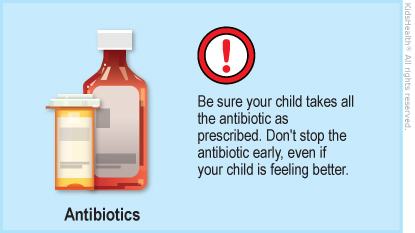
Illustration of medicine/antibiotics with English instructions

Care Instructions

  • Be sure your child takes all the antibiotic doses as prescribed, even if they feel better. This is the best way to kill the harmful germs.
  • For throat pain or fever, you can give acetaminophen (Tylenol® or a store brand) or ibuprofen (Advil®, Motrin®, or a store brand). Follow the package directions for how much to give and how often. Don't give ibuprofen to babies under 6 months old.
  • Don't give aspirin to your child or teen. It can cause a rare but serious illness called Reye syndrome.
  • In kids 6 years and older:
    • Offer a throat lozenge. To prevent choking, make sure your child is sitting up and awake and that an adult is nearby.
    • Try a saltwater gargle a few times a day. Mix ¼ teaspoon of salt in 8 ounces of warm water and have your child gargle, then spit out the saltwater.
  • Offer your child plenty of liquids. Warm herbal (no caffeine) tea, soup, watered-down white grape juice, an oral electrolyte solution (such as Pedialyte® or a store brand), and water are all good choices. Crushed ice or flavored ice pops will also help your child stay hydrated. Babies can continue to breastfeed or take formula. 
  • If your child is having trouble drinking, try giving small amounts of liquids every few minutes through a straw, an oral syringe, a medicine cup, or a kitchen teaspoon.
  • Offer your child soft foods that are easy to swallow. Avoid salty, spicy, crunchy, or acidic foods (like citrus fruits), which can irritate a sore throat.
  • Let your child rest as needed.
  • Your child can return to childcare or school when they have taken the antibiotic for 12 hours, are fever-free, and are feeling better.
  • Follow up with your healthcare provider as instructed.

Your child:

  • Has throat pain that gets worse
  • Doesn't start to feel better within 3 days of starting the antibiotic
  • Gets a new or higher fever or still has a fever after 2–3 days on the antibiotic
  • Gets new symptoms, such as a rash, a cough, ear pain, or vomiting
  • Is eating or drinking very little
  • Develops joint pain or tea-colored pee (These are rare problems that can happen after having strep throat.)

Go to the ER if...

Your child:

  • Isn't drinking at all or has signs of dehydration, such as a dry or sticky mouth, sunken eyes, less pee or darker pee than usual, little or no tears when crying, or unusual sleepiness
  • Has very severe throat pain, neck swelling, difficulty opening and closing the mouth, voice changes, trouble swallowing or breathing, or drooling

You know your child best. If your they have symptoms that worry you or seem very sick, call your healthcare provider or take your child to the ER.

More to Know

What are the symptoms of strep throat? Kids with strep throat can have a sore throat, trouble swallowing, fever, headache, and swollen glands in their neck. They might also have belly pain, feel sick to their stomach, and throw up.

What problems can happen after strep throat? Although it is rare, the infection can spread or lead to joint or kidney problems. These problems are much less likely to happen if a child takes the antibiotic exactly as prescribed.

How do healthcare providers diagnose strep throat? If a healthcare provider thinks a child may have strep throat, they can do a throat culture. The throat culture checks for different types of bacteria, including the bacteria that causes strep. To do a throat culture, the healthcare provider rubs a cotton swab (like a long Q-tip®) on the back of the throat. The swab is then used for one or both of the following:

  • To do a "rapid" strep test to check for the bacteria that causes strep throat. The results are back in a few minutes.
  • To be sent to a lab to see if strep or other bacteria are causing the sore throat. These results are back in 1–3 days.

Can strep throat be prevented? There is no vaccine to protect against strep throat, and getting strep throat once doesn't protect someone from getting it again. To help prevent the spread of strep throat, kids (and adults) should:

  • Wash their hands well and often with soap and water. Scrub for at least 20 seconds, rinse, and dry thoroughly. If soap and water aren't available, use a hand sanitizer with at least 60% alcohol.
  • Avoid sharing food, drinks, dishes, eating utensils, napkins, or towels with others. Wash dishes in hot, soapy water.
  • Cover their mouth and nose with a tissue when coughing or sneezing, then throw it away and wash their hands. If a tissue isn't available, they should sneeze or cough into their elbow or upper arm, not their hands.
Learn More
