Costochondritis: How to Care for Your Child

Costochondritis is an inflammation (irritation) of the cartilage that attaches the ribs to the breastbone. Cartilage is a bendable material that lets the ribs move a little.

Costochondritis causes pain and soreness where the ribs meet the breastbone. The pain can get worse when your child takes a deep breath, coughs, moves the upper body a lot, or presses on the area.

Costochondritis usually goes away on its own within a few weeks with basic home care.
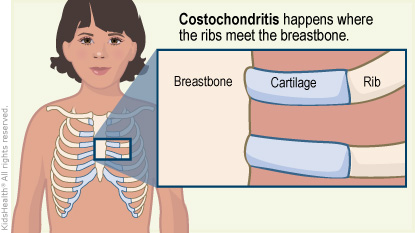
Illustration: costochondritis

Care Instructions

  • You can give acetaminophen (Tylenol® or a store brand) or ibuprofen (Advil®, Motrin®, or a store brand) as needed for pain. Follow the directions on the label for how much to give and how often.
  • Don't give aspirin to your child. It can cause a rare but serious illness called Reye syndrome.
  • If your child finds it soothing, you can put ice or heat on the area for 20 minutes a few times a day. Be sure to put a thin towel between the ice or heat and the skin to prevent injury to the skin.
  • Tell your child not to press on the sore areas.
  • Help your child avoid activities that make the pain worse (such as carrying backpacks, lifting, or sports that involve the upper body).
  • Once your child’s costochondritis is better, be sure they wear their backpack straps evenly over both shoulders.

Your child:

  • Has pain that gets worse or moves to another part of the chest
  • Develops other symptoms like shortness of breath or feeling more tired when doing physical activity
  • Still has pain after 2–3 weeks

More to Know

What causes costochondritis? Costochondritis can happen after:

  • A hit to the chest
  • Lifting something heavy (such as a backpack)
  • Doing a lot of physical activity
  • Coughing a lot

Sometimes the cause isn't known. Costochondritis is NOT a sign of a heart problem.

How do I know what activities are OK for my child? Your child should immediately stop doing any activity that causes pain. Sometimes kids have to take a break from sports or need help carrying things until the costochondritis goes away. Ask your healthcare provider if you're unsure about what's OK for your child.

Learn More

