Abrasion: How to Care for Your Child

An abrasion is a scrape of the top layer of skin. They usually heal well with basic home treatment. Here’s how to care for your child.
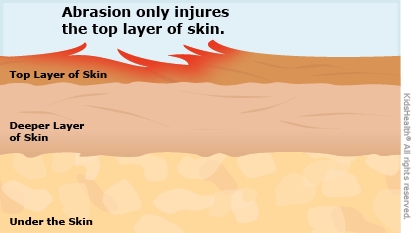

Illustration of labeled skin layers. Abrasion only injures the top layer of skin.

Care Instructions

  • Wash the abrasion with fragrance-free soap and water (no scrubbing) and pat dry with a clean towel every day until healed. Don't use alcohol or hydrogen peroxide, as they can irritate the abrasion.
  • If your healthcare provider recommended it, apply antibacterial ointment such as bacitracin, Neosporin®, or Polysporin®. These are available online or at a pharmacy without a prescription.
  • Until a scab forms, cover the abrasion with a nonstick bandage. After a scab forms, you don't need to keep the abrasion covered. Do not allow your child to pick at the scab.
  • For discomfort you can give acetaminophen (Tylenol® or a store brand) or ibuprofen (Advil®, Motrin®, or a store brand). Follow the package directions for how much to give and how often. Don't give ibuprofen to babies under 6 months old.

  • The area around the abrasion becomes more painful, red, or swollen.
  • The abrasion starts to drain yellow or green fluid (pus).
  • Your child gets a fever.

More to Know

How does an abrasion happen? Most abrasions in kids happen when they fall. An abrasion may also happen when someone rubs up against a rough surface.

What does an abrasion look like as it heals? At first, an abrasion can look wet or ooze a little clear fluid. As healing continues, the fluid dries and a scab forms. The scab slowly goes away.

Learn More
